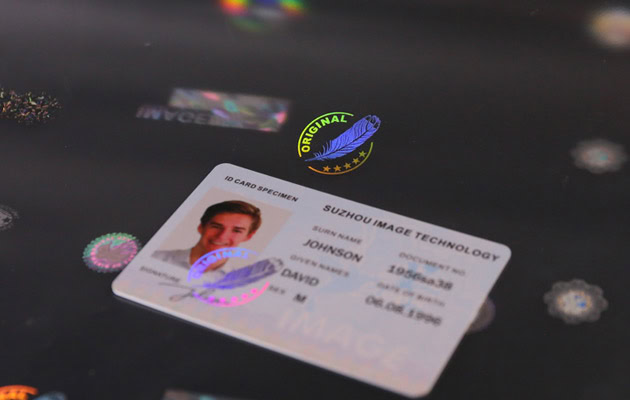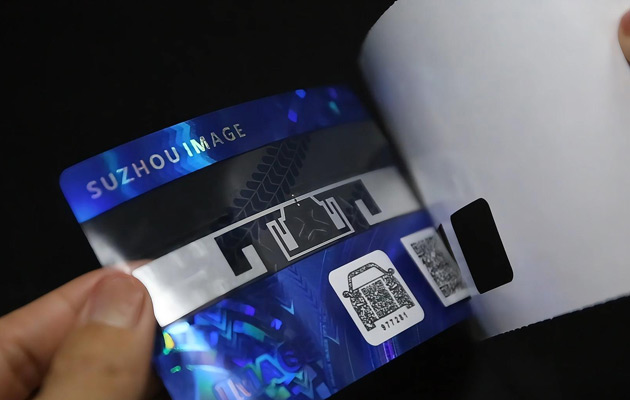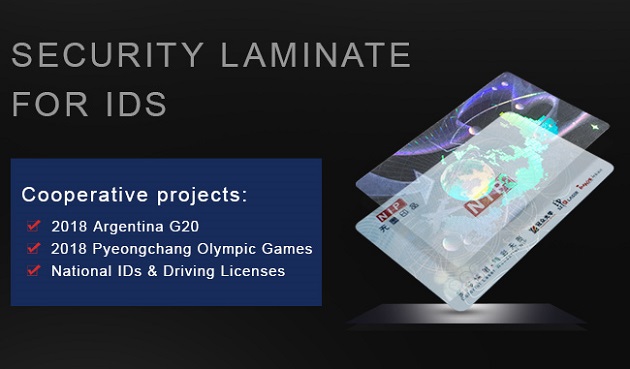
In many paper document projects, hologram registered hot stamping foil not only has visual anti-counterfeiting functions, but also plays an important security authentication role.
Whether it is birth certificates, real estate certificates, vehicle registration certificates, lawyer qualification certificates, visa labels, passport pages, or other paper document products, holographic registered hot stamping technology is widely used to improve the security level of certificates.
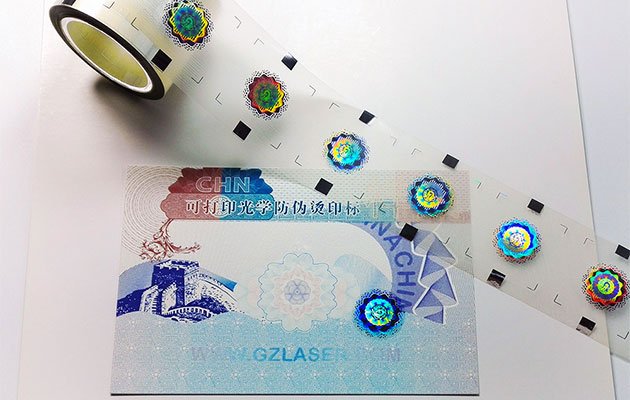
These holographic images not only provide intuitive visual recognition, but also have high physical anti-counterfeiting capabilities, which are not easy to copy, transfer, or tamper with by people.
However, we received some customers’ inquiries:
For the hot stamping materials provided by their suppliers, the holographic image initially worked well, but abnormal phenomena of varying degrees appeared in the subsequent production process, such as:
- The aluminized layer is yellow.
- The brightness of the holographic image decreases.
- Pattern integrity is affected.
After analyzing and testing customer samples, we found that the problem occurred in the laser personalized printing process.
Why does laser printing affect holographic images?
For the certificates manufacturing industry, laser printing is a common personalized information processing method. Before issuing, it is usually necessary to print the holder’s name, ID number, validity period, photo, barcode or QR code, and other information.
Unlike ordinary inkjet printing, laser printing requires high-temperature fixing technology to firmly attach toner to the paper surface.
During this process:
- Toner is transferred to the surface of the certificate.
- The fixing component melts and fixes the carbon powder.
- The internal temperature of the equipment can usually reach 150℃ to 180℃.
- The temperature of some high-speed equipment or industrial-grade equipment can even approach 220℃.
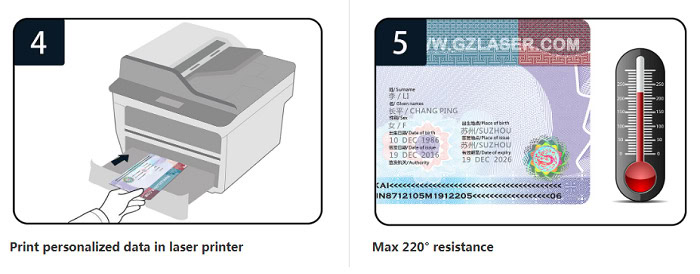
For ordinary package-grade hot stamping materials, such temperatures have exceeded their design range.
Under the action of continuous high temperatures, materials may appear:
- · Oxidation of the metallization layer;
- · Coating discolored;
- · Adhesive layer failure;
- · Damage to the micro-nano optical structure;
- · The holographic image effect is reduced.
Therefore, many problems seem like “post-printing damage”. They actually stem from the poor adaptability of hot stamping materials to laser printing conditions.
Why do document projects require higher requirements for hot stamping materials?
The holographic hot stamping material on ordinary commercial packaging is mainly used for shelf appeal and brand image enhancement. The security features in the paper document project need to run throughout the entire certificate life cycle.
Therefore, in many international document projects, materials not only need to have anti-counterfeiting properties, but also must meet the following requirements:
- High temperature resistance and can withstand a laser printing environment.
- Wear-resistant and will not fade after long-term use;
- Aging resistance and stable long-term storage performance;
- Tamper-proof, preventing transfer and reuse;
- The optical effect is stable and consistent before and after personalized printing.
For government documents, holograms are not simply visual elements, but one of the important primary security features. Once the optical effect fails, the security identification ability of the document will also be affected.
How does Image Technology’s material adapt to the laser production environment?
Compared with ordinary packaging hot stamping foils, certificate-grade high-temperature resistant hot stamping foil materials need to be specially designed for the laser printing environment.
The high-temperature-resistant hot stamping foil provided by our Image Technology can meet the needs of the laser printing environment.
For example, he has a heat-resistant coating system that can improve the heat-resistant stability of the metallization layer and reduce the risk of high-temperature oxidation.
The high-temperature-resistant adhesive layer design ensures that the material still maintains stable adhesion in a high-temperature environment.
Micro-nano optical structure protects and reduces the impact of high temperatures on holographic images and optical characteristics.
Precise positioning and hot stamping ensure the optical security pattern is accurately stamped onto the required area, and improve recognition reliability.
After targeted structural optimization, the holographic image can maintain good pattern integrity, color stability, and optical recognition even after passing through a laser printing environment of 175 ° C to 220 ° C.
Modern document manufacturing not only requires security features, but also requires them to be able to adapt to subsequent personalized production processes.
If a holographic registered hot stamping cannot withstand the high-temperature environment during the laser printing process, it will be difficult for it to meet the true certificate-level applications.
Therefore, when selecting document security foil materials, in addition to paying attention to the holographic pattern itself, we should also pay attention to their high temperature resistance, laser printing compatibility, and long-term use stability.