In secure ID document projects, there are two steps are necessary. One is adding overlay lamination onto it, and the other is personalization. However, many customers have problems with them. Especially in the laser printing personalization process, bulging is a common issue.
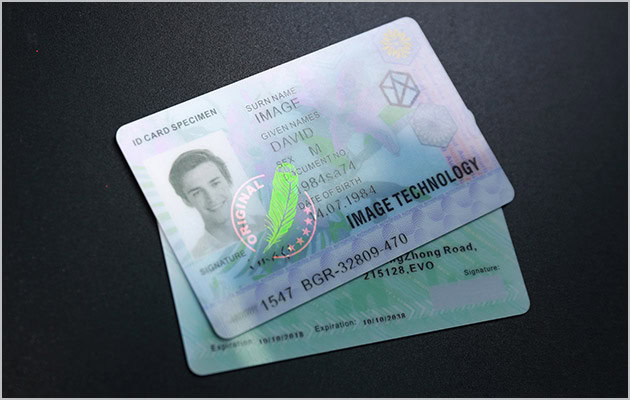
After doing optical lamination on PC cards, everything seems fine. But after laser printing, the card surface shows issues such as bulging, peeling, and unevenness.
This not only affects the appearance of the ID document. It raises concerns about the long-term durability of documents.
Customers often think that the problem is with the PC embedded laminate overlay. In many cases, the problem does not come from the overlay. It is related to various factors, such as the materials used to make the PC card, the laser printing process, the lamination, and so on.
First, let’s understand how laser personalized printing works.
To know what causes a bulge, we need to know how laser printing works.
A PC card can be printed with information using a laser process. Because it has a laser-sensitive layer. This layer has additives that are based on carbon.
When the laser shines on the material, these additives carbonize, forming text, photos, and other information.
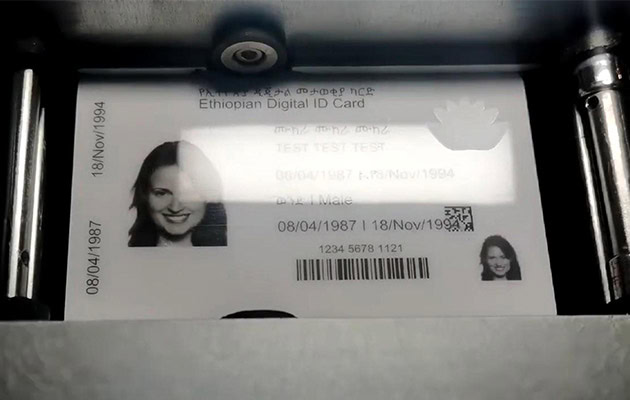
Also, laser printing has some advantages, like being able to withstand wear and tear, being hard to tamper with, and lasting a long time. That is why many important ID documents use this technology.
Problems often arise during the laser action. When the laser affects the material, a local high-temperature reaction occurs. Some additives release gas.
If the card surface is without any lamination layer, these gases can go out. For a PC card with an embedded overlay, it’s different.
The overlay covers the card body, forming a structure. When the gas can’t be released, it accumulates in areas.
The final result is:
- surface bubbling
- partial overlay lifting
- Card surface uneven
- Optical effects affected
The bubbling phenomenon isn’t the overlay bulging out. It’s the gas trapped in the structure.
Can reducing carbon-based additives solve the problem?
Some customers may have an idea, so why not reduce additives? Actually, it’s not that simple.
Reducing additives may lower the bulge risk. It may also cause:
- Print gray
- insufficient darkness
- Portrait not clear
- Text contrast drops
- Automatic recognition performance deteriorates
These issues are unacceptable for identity documents. The real challenge is finding a balance between the printing effect and the stability of the structure.
This is also a direction for PC material manufacturers to continue to work on in the long term.
What can PC embedded Overlay suppliers do?
Although the bulge problem is a comprehensive and complex issue, as a supplier of PC embedded overlay with more than 20 years of experience, we can help with challenging project issues.
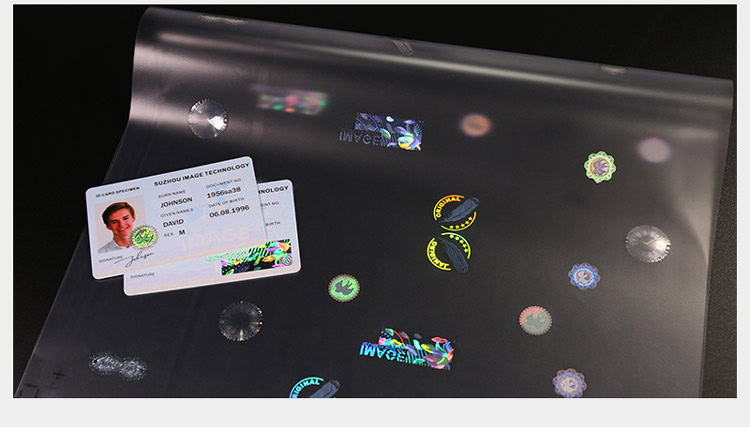
From the laminated structure perspective, we focus on:
- Overlay structure design
- Temperature and pressure control
- Stability test after laser personalization
- Compatibility test between PC materials
In projects, we can test and verify with PC material manufacturers together.
Because with the same laser equipment and the same lamination process, the performance of different PC material formulations may be very different.
When a blister appears in a PC ID document, it doesn’t mean the embedded overlay has a quality problem. Maybe because of the properties of PC materials, DOVID, the lamination process, laser process, etc. It is not one reason; it hinges on how well the material and process work together.
For high-level ID projects, optimizing one link has a limited effect. What matters is finding a proven material combination and process matching scheme. The long-term stability of ID documents depends on the coordinated performance of the system.