After looking back at 40 years of holography and optical security in China, there’s another question worth exploring: What does holography really mean?
Is it simply a technique for recording and reconstructing light, or does it offer a broader way of thinking about information, the relationship between parts and the whole, and the world around you?
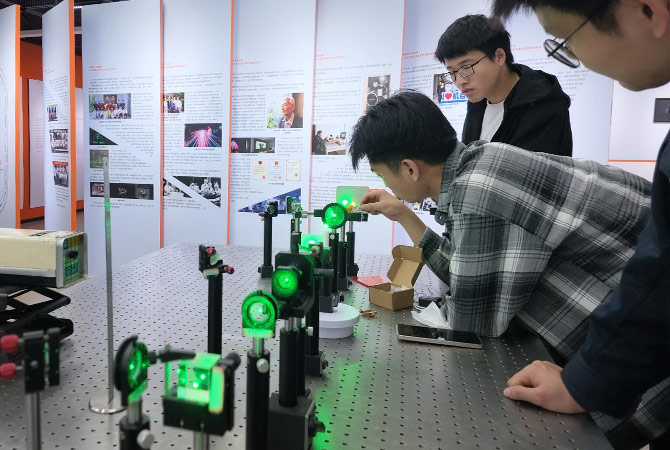
In the curator’s note below, you’ll find reflections on holography from several perspectives, including physics, mathematics, biology, cosmology, and philosophy.
These ideas also help explain why holography goes far beyond anti-counterfeiting and packaging, with many more possibilities to explore.
Curator’s Note
What does “holography” truly signify? In the curator’s note below, Hu Zuyuan, Chairman of Suzhou IMAGE TECHNOLOGY, shares his thoughts on holography from multiple perspectives.
Let’s start with physics.
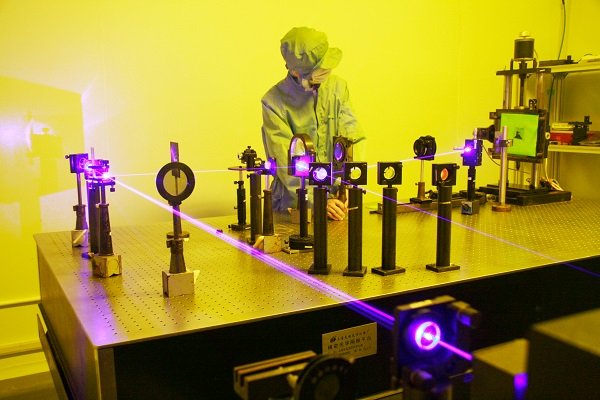
Holography records the phase information of light through interference. It encodes the light field of an object in a recording medium, allowing that information to be reconstructed at another time and in another place.
At its heart, holography is based on two key processes: recording through interference and reconstruction through diffraction.
Holography was first proposed as a way to improve the resolution of electron microscopes. Since then, it has found its way into many other fields, including 3D imaging and display, data storage, specialized optical components, interferometry, and art.
Now, let’s look at the mathematics behind it.
Holography relies on linear systems, Fourier transforms, and wave propagation through diffraction. Interference encodes phase information into an intensity pattern, and diffraction uses that pattern to reconstruct the wavefront.
Today, holography goes far beyond traditional optical recording. With precise computer algorithms and semiconductor nanolithography, we can create diffraction patterns and reconstruct holographic interference fringes in a recording medium. In doing so, we can see the mathematical beauty of light waves interacting.
What about biology?
In living organisms, individual cells and certain parts of an organism can retain information about the whole. A part of the human body may carry information related to the entire organism, while a single leaf or branch can contain information essential to the growth of the plant as a whole.
This idea is often described as biological holography. It points to a fascinating way of thinking: the whole may, in some sense, be reflected in its parts.
Then there’s the universe.
Nobel laureate Gerard ’t Hooft and other physicists have helped develop ideas that challenge how we understand reality, including the holographic principle.
The basic idea is fascinating: information about a volume of space may be described by information encoded on its boundary. In this view, the three-dimensional world we experience may be understood through information represented in a different way, much like an image reconstructed from a hologram.
And finally, let’s turn to philosophy.
One of the central ideas often associated with holography is that the part and the whole may be more deeply connected than we think.
This may remind you of some much older ideas. In Buddhist Huayan philosophy, there is the concept that “one is all, and all is one.” Taoist thought speaks of the unity of humanity and nature. And in the 17th century, the German philosopher Gottfried Wilhelm Leibniz proposed that each monad reflects the entire universe.
These ideas emerged in very different times and traditions, but they share a striking similarity in the way they explore the relationship between the part and the whole.
The Chinese character yin (印) means the act of recording or imprinting, while xiang (像) means the image that appears. Between the moment of recording and the image that is brought back to life, holography offers us a way to look at the world.
So, what you see here today is only a small glimpse of something much bigger.
When it comes to anti-counterfeiting packaging, for example, what we do with holography is just one small step in a much longer journey. This exhibition is simply one footprint along that road.
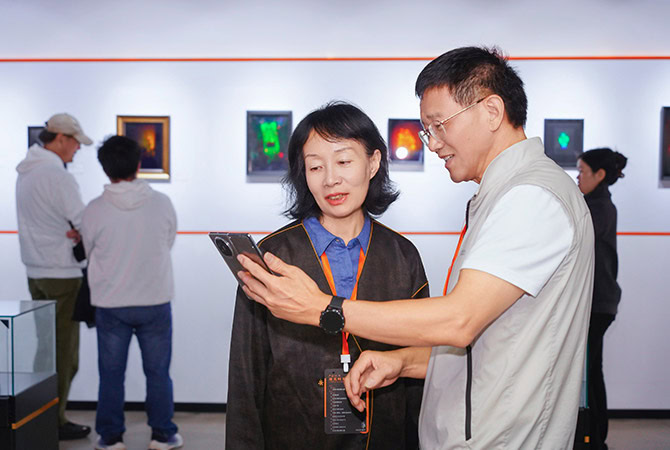
There is still a long way to go, and much more for us to explore.
Beyond the Exhibition: The Journey Continues
The Holography Technology Art Works Exhibition is a chance to look back, share ideas, and explore what comes next.
When you visit the exhibition, you can take a closer look at different holographic artworks and optical technologies, learn more about the ideas and techniques behind them, and share your own experiences with others in the industry.
We hope the works on display will bring you not only visual surprise. We also hope they’ll spark conversations about technology, art, and new possibilities for holography.
If you work in holography, optical security, security printing, or a related field, we’d love to welcome you to the exhibition in Suzhou.
For details about the exhibition and visitor appointments, please see the full exhibition details here.
We look forward to meeting you in Wangshan, sharing ideas, and exploring more possibilities for holography together.