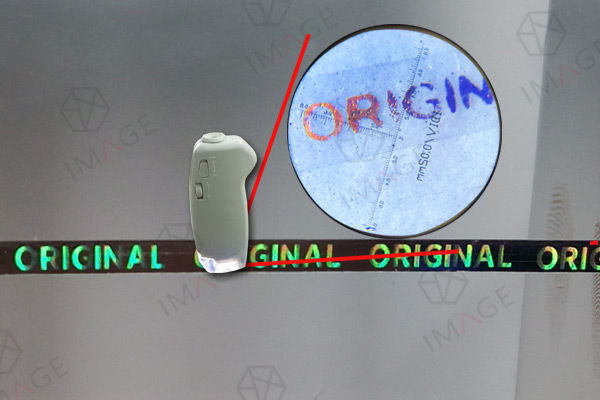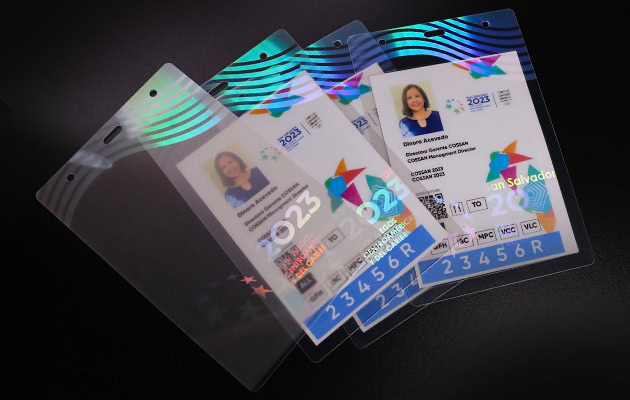
When we talk with customers, we often see this situation. When they see our products, their first reaction is often: “That’s a laser effect?” Or: “It’s a hologram?” In fact, this understanding is not completely correct.
For a long time, the market has been accustomed to collectively referring to all products that don’t use ink and can present rainbow colors, metallic luster, or dynamic visual effects as “laser products” or “holographic products.”
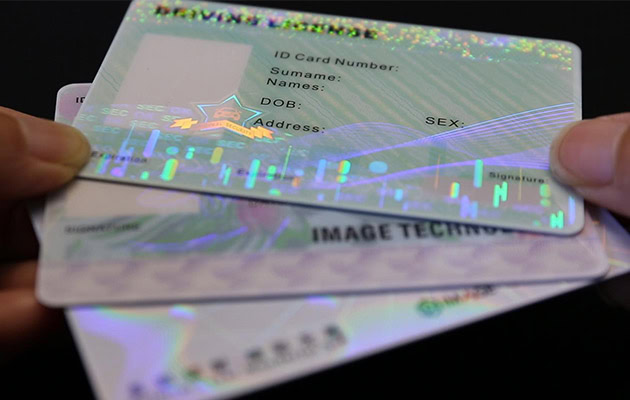
This perception is widespread in the fields of packaging printing, anti-counterfeiting, and decoration, so many people take it for granted that as long as the product surface shows a color change with changes in light, it is a laser or a hologram.
However, with the development of micro-nano manufacturing technology, this traditional understanding can no longer accurately describe today’s optical structured color products.
In fact, laser, hologram, and structural color are not the same concept; they represent different technical levels.
Laser, hologram, and structural color are not the same thing
First of all, we need to be clear: Laser is a processing tool. Hologram is an optical technology. Structural Color is a physical color rendering principle. There are both connections and essential differences between the three.
Many people think that “laser” represents a product type, but in fact, “laser” is just an early Chinese translation of leishe.
Lasers are widely used in many fields, such as medical beauty, welding, precision measurement, communication transmission, and semiconductor manufacturing, and are not limited to the packaging and printing industry. In the manufacturing process of micro-nano structures, lasers are also just one of many processing tools.
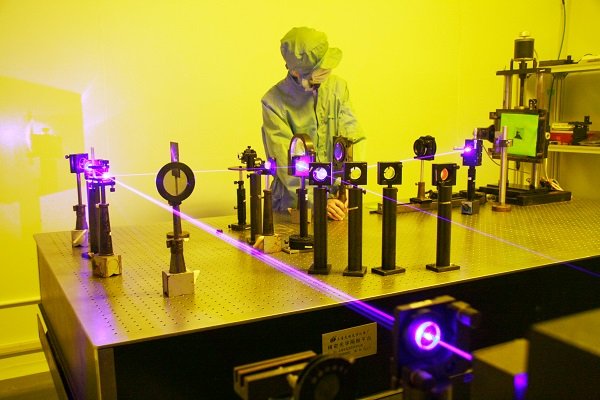
Holography technology uses lasers to record light wave interference information, form micro-nano structures on the surface of the material, and produce special visual effects such as rainbow colors, dynamic images, and three-dimensional effects through light diffraction.
Therefore, it can be said that holographic technology is a method to realize structured color. But structural colors go far beyond holograms.
Structural color is a broader optical technology system
Structural colors are also called physical colors. Unlike traditional ink printing that relies on pigments for coloring, the color of structural colors comes from the interaction between light and micro-nano structures.
These effects include: diffraction, reflection, refraction, scattering, and optical resonance. When light shines on the surface of a specific micro-nano structure, light of different wavelengths will produce different propagation behaviors, thus forming rich colors and visual effects.
Many of the amazing colors in nature come from structural colors. For example, peacock feathers, butterfly wings, beetle shells, and mother-of-pearl shells, their bright and lasting colors that come not from pigments, but from the micro-nano structures on their surfaces.
Modern structural color technology is inspired by these natural phenomena and achieves ink-free visual presentation by manually constructing micro-nano structures.
Laser holography is just one branch of structured color technology
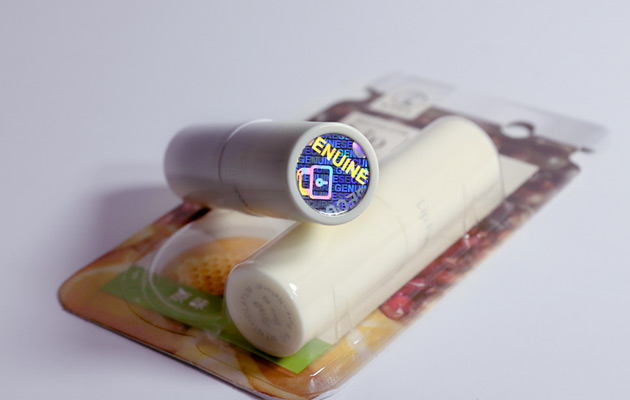
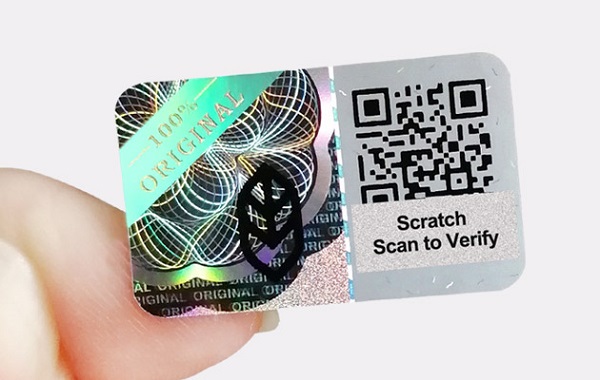
In the past few decades, holographic stickers have been one of the most successful and widely used commercial products of structured color technology.
Since early holographic products mainly relied on laser recording and reproduction, the industry gradually formed traditional terms such as “laser label” and “laser packaging”.
But today, micro-nano structured color technology has long broken through the boundaries of traditional holographic technology. With the development of semiconductor manufacturing technology, more and more advanced micro-nano processing processes have been introduced into the field of structural colors.
Currently, common structural color processing technologies include:
- Holography
- Semiconductor lithography technology
- Electron beam lithography
- Ultra-precision CNC
- Plasma process
- Electrochemical

These technologies can create micro-scale or even nano-scale structures on the surface of materials, achieving visual effects and functional performances far beyond traditional holographic products.
In other words, laser holography belongs to structural color. But structural color is not equal to laser holography. If traditional “laser products” are used to define all today’s micro-nano structured color products, it is undoubtedly a too narrow understanding.
The Global Industry Is Evolving
In fact, this cognitive shift is occurring not only at the technical level, but also at the entire industry level. In the past few decades, the concept of “Hologram Industry” has been widely used in the global optical security industry.
In recent years, more and more companies around the world have started using broader industry terms like Optical Security, Optical Authentication, Nano-Optics, Photonic Structures, and Optical Effects.
Because the industry has realized that the future development direction is no longer limited to holograms, but the entire optical micro-nano structure technology system.
One big event that shows this change is that the International Hologram Manufacturers Association (IHMA) changed its name to the International Optical Technology Association ( IOTA).
This change is not only an adjustment of the name, but also reflects the upgrade of awareness in the entire industry. From the “holographic era” to the “optical micro-nano structure era” has become an important trend in the development of the global industry.
Common Misconceptions About Structural Color Products
As Structural Color Products are used in more areas, different opinions have started to appear.
One common idea is that the color of Structural Color Products changes when you look at it from different angles and is not as stable as traditional printing. This is actually one of the most important features of Structural Colors.
Traditional printing uses ink to present colors, so the color is stable. Structural Colors present different visual effects under the refraction, reflection, and diffraction of light. This change is the uniqueness of the micro-nano structure color.
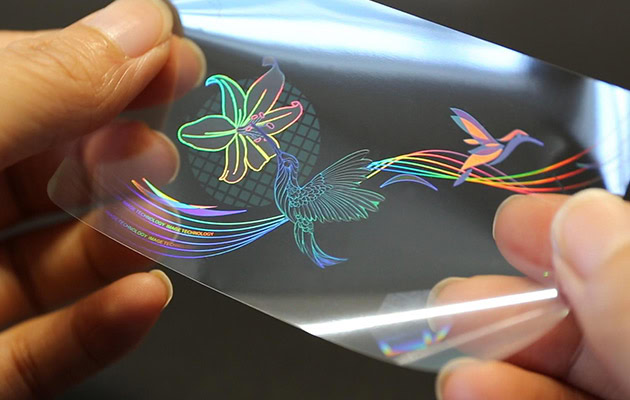
These features make products look more special and visually appealing, which is hard to achieve with traditional printing.
Another common view is that products without ink look too simple compared to printed packaging.
This is because, for a time, people thought that good packaging had to have a lot of ink, complex designs, and many decorative processes.
As people’s preferences change, more and more brands want simplicity, environmental friendliness, naturalness, and a sense of technology.
Structural Color Products offer a way to express visual ideas. Instead of using a lot of printed color, they use light and shadows as design elements.
This makes the brand logo and message stand out while also catering to what consumers want today: innovativeness and unique modern design.
No Ink Optical Micro-nano Structure Will Not Replace Printing
There is another question that many people in the Global Industry are asking: will this ink-free optical microstructure replace traditional printing? Our answer is no.
Traditional printing has a foundation and is used in many areas that cannot be replaced. Structural Color ink-free prints are a direction in green printing. The two are not competing. Rather complementing each other.
Traditional printing is used to show information and colors. Structural Colors are used to provide benefits, technological texture, and unique visual value.
In the future, it is likely that the two technologies will coexist and be combined in ways depending on what is needed.
Structural Colors can be used on their own or with a bit of ink for printing, giving brands more design options.
What We Do Is Not “Laser Products”
Based on this technology, we believe that what Image Technology develops and manufactures is not traditional laser products. What we focus on is micro-nano structure color visual products.
A laser is one of the tools we use to make products. Holography is one way to achieve this. The structural color is the foundation of the product.
From packaging labels and brand enhancement solutions to identity documents and optical security materials, our goal is to control light through micro-nano structures to create more sustainable, innovative, and visually engaging products.
If laser holography was a part of the optical vision industry in the past, then micro-nano structural color is starting a new era.
It is not a new technology but also a new way of thinking about environmental protection, design, aesthetics, and manufacturing methods. This is where the true value of Structural Color lies.