In the impression of many people, woven labels are just ordinary labels sewn on clothing, shoes, hats, or bags to mark brand, size, and material information. But you may not know that a small silk thread in the woven label can also become an important carrier for brand anti-counterfeiting.
For the clothing, shoes, hats, and luggage industries, the number of products is large, and the unit price is relatively low. Many traditional anti-counterfeiting solutions are costly and difficult to apply on a large scale.

The security thread provides a solution that balances cost and effectiveness.
It weaves thin threads with optical anti-counterfeiting features directly into the woven label. Whether they are used as warps or wefts, they can be woven together with ordinary yarns, achieving product anti-counterfeiting without changing the original production process.
Small 0.7 mm, but behind it is precision processing
In order to adapt to the production of woven labels, the width of the security thread is usually controlled within 1 mm, and common specifications are 0.7mm, 0.8mm, and 1.0mm. Among them, 0.7mm belongs to the high-precision security thread.
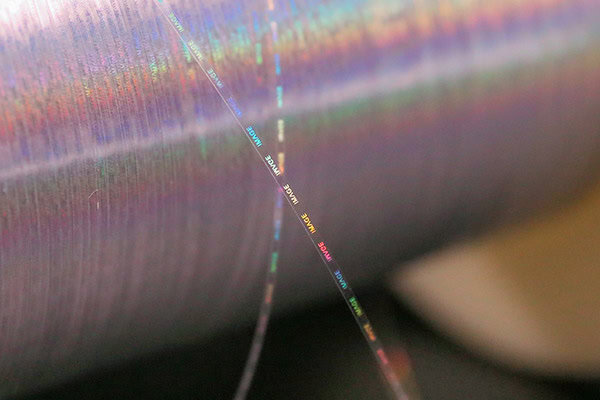
Although it is as thin as a human hair, it carries rich optical information and brand identity information. Such a tiny size places extremely high requirements on materials, micro-nano structure design, lithography mould manufacturing, and precision slitting process, and there are technical thresholds.
Achieve mass anti-counterfeiting at low cost
Many brands are concerned that anti-counterfeiting measures will increase product costs. In fact, the material utilization rate of anti-counterfeiting thread is very high.
After precision slitting of one square meter of material, about 1000 meters of anti-counterfeiting thread can be obtained, which can be applied to tens of thousands of woven labels.
The cost allocated to individual clothes, shoes, hats or luggage is quite low, but it can effectively improve the brand’s ability to combat fake products.
Does not affect weaving efficiency
The security thread can be directly mixed with ordinary yarn without changing the existing label production process.
At the same time, spools of different sizes can be matched according to customer equipment specifications, which is convenient for direct use on existing looms, reduces introduction difficulty, and improves production efficiency.
Multiple security features for easier identification
In addition to its unique optical effects, security threads can also integrate a variety of security technologies.
For example, high-precision micro text technology can observe clear text information through a 40x magnifying glass, and more small nano-text content can be observed after further zooming in.
At the same time, it can also combine multiple anti-counterfeiting technologies, such as flip-flop, dynamic scaling, and neon color to form a first-line, second-line, and third-line anti-counterfeiting system, achieving multi-level verification from consumers to professional institutions.
Balancing aesthetics and durability
In addition to its anti-counterfeiting function, this thread also has rich color expression and strong visual appeal, which can improve the overall design and quality of brand woven labels.
In view of the frequent washing characteristics of the clothing industry, this product also has good washing resistance and high temperature resistance, which can meet the long-term use needs of clothing, shoes, hats, and luggage products.
Why is it difficult to copy?
The reason why security threads have high anti-counterfeiting value mainly comes from three aspects:
- Complex design of micro-nano optical structures;
- High manufacturing equipment and process barriers;
- Combination application of multiple anti-counterfeiting technologies.
For counterfeiters, not only difficult to copy, but the input cost is often much higher than the proceeds of counterfeiting, so the threshold for counterfeiting can be effectively raised.
A seemingly ordinary woven label security thread combines micro-nano optics, precision manufacturing and a variety of anti-counterfeiting technologies.
With its advantages of low cost, easy to use, difficulty in imitation, and beauty, it has gradually become an important choice for brand protection in clothing, straw hats, bags and other industries.