In our previous part, we shared why we are hosting the Holography Technology Art Works Exhibition – to look back on the development of the industry, re-understand holography, and think about its future possibilities.
Now, let’s look at how the industry has developed over time.
From the early experiments that introduced holography to China, to the industrialization of embossed holograms and the emergence of new optical technologies, each milestone reflects the work and ideas of people who helped move the field forward.
The following chronology brings together key moments in the development of holography and optical security in China, leading up to the industry’s 40th anniversary in 2026.
Holography Origins
1948 Gabor used a mercury lamp to capture the world’s first hologram, for the first time completely recording all the information of a light wave (amplitude and phase). Holography was born.
1960 The first ruby laser was introduced, helping holography enter a practical development stage ahead of schedule.
1962 Leith and Upatnieks produced the first laser hologram.
1971 Gabor won the Nobel Prize in Physics for inventing holography, and holography received the highest academic recognition.
1983 MasterCard first used a hologram on credit cards, opening the commercialization of holographic anti-counterfeiting.

1973: The Laser Technology Exhibition was held in Tianjin, featuring the first-ever Chinese-made hologram.
1983: A French holography exhibition took place at the Beijing Exhibition Center; the large-scale holographic works left a profound impact on every visitor.
1984: An exhibition showcasing the applications of holographic technology was held at the Beijing Building Materials Exhibition Hall to mark the 35th anniversary of the founding of the PRC.
1985: A holography exhibition was held in Suzhou.
1985: The Holography and Optical Information Processing Professional Committee of the Optical Society of China was established.
1986: Holographic manufacturing enterprises were established simultaneously in Qingdao and Shenzhen, marking the beginning of the industrialization of embossed holograms in China.
1987: Holographic technology was applied commercially for the first time on an official postage stamp folder for the Year of the Rabbit.
1988: China’s first batch of anti-counterfeiting labels—used for “Zhangguang 101,” “999 Weitai,” and “Monkey King” (Houwang) tea—were put into use.
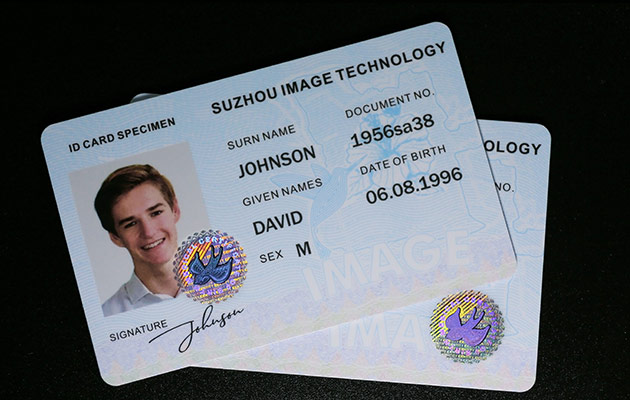
1989: Holographic anti-counterfeiting technology was applied to resident identification cards on Hainan Island, marking its entry into the realm of official state-issued ID documents.

1993: The International Hologram Manufacturers Association (IHMA) was founded, providing a unified coordinating body for the global holography industry.
1995: The China Anti-Counterfeiting Industry Association was established in Tai’an, Shandong; the China Anti-Counterfeiting Technology Association (under the Ministry of Public Security) was also founded.
1996: The International Conference on Holography and Optical Information Processing (ICHOIP ’96) was held in Nanjing; the iconic Chinese holographic work “Peking Opera Facial Masks” was unveiled.
1993: The first laser-holographic tobacco packaging was produced and put into use in Shenzhen.
1999: The state issued the “Measures for the Supervision and Administration of Product Anti-Counterfeiting,” which designated holographic anti-counterfeiting as a recommended technology, initiating the standardization of the industry.
2001: Pixelated dot-matrix interference lithography emerged; dynamic optically variable devices (OVDs) overcame the limited viewing angle issues inherent in traditional holograms.
2003: Spatial light modulation lithography introduced digital imaging, enabling effects such as true-color, dynamic motion, and three-dimensional depth.
2004: China’s second-generation national ID cards began incorporating holographic anti-counterfeiting marks.
2005: The “Holo-pack·Holo-print 2005” conference—an annual industry event organized under the International Hologram Manufacturers Association (IHMA)—was held at the Wuzhou Guest House in Shenzhen.
2008: The “General Technical Requirements for Holographic Anti-Counterfeiting Products” was released, establishing an initial technical threshold and standards system for the industry.
2009: The 8th International Symposium on Display Holography (ISDH) was held in Shenzhen, hosted by the Shenzhen-based company Fancaiyi (Shenzhen Fancaiyi Holographic Technology Co., Ltd.).
2013: Optical Fresnel lens technology emerged, creating a “platinum relief” effect that gained widespread popularity in the packaging sector.
2014: New hologram transfer overlays were introduced for the card-style electronic permits for travel to and from Hong Kong and Macau.
2015: Suzhou Image Technology launched the “No-ink Printing” brand, utilizing micro-nano structural colors to achieve printing without the use of ink.

2019: A group standard titled “General Technical Specifications for Micro-Nano Structural Color Inkless Prints” was promulgated, with holographic diffractive colors recognized as a significant category of structural color.
2019: The International Light and Shadow Magic Exhibition was held at the Shanghai Science and Technology Museum.
2020: Hologram stickers increasingly integrated with QR codes and RFID, building a verifiable and traceable “trusted digital foundation.”

2021: New technologies such as microlens imaging and “motion” (levitation/floating) effects emerged, while volume holography made a comeback, driving the diversification of optical anti-counterfeiting solutions.
2024: Several holographic artworks from the Beijing Institute of Graphic Communication were selected for a parallel exhibition at the Beijing International Photography Week.
2025: The International Hologram Manufacturers Association (IHMA) was officially renamed International Optical Technology Association (IOTA), marking the evolution of holographic anti-counterfeiting into the broader field of optical security identification.

2025: The “Light Impressions: A Special Holographic Exhibition Celebrating 70 Years of China-Serbia Friendship” was held in Serbia.
2026: Marking the 40th anniversary of China’s holographic anti-counterfeiting industry, the “Holography Technology Art Exhibition” opened in Suzhou.
Looking back at the road traveled, set out again.
Beyond history, what else is worth exploring further?
Forty years of development is more than a sequence of dates. Behind every milestone are people exploring new possibilities, solving technical challenges, and finding new ways to apply optical technologies.
The works brought together for the Holography Technology Art Works Exhibition offer another way to explore this history—not only through written records, but also through the actual images, optical structures, and creative achievements produced along the way.
And while the chronology looks at what has happened, it also raises a bigger question: what does holography mean beyond its practical applications?
That is the question explored in the curator’s statement, the next part of this series.