ID card lamination is a critical component of card security. To achieve the desired results, you cannot ignore small details in the laminating process, such as laminating temperature, speed, laminating position, and other matters that need attention.
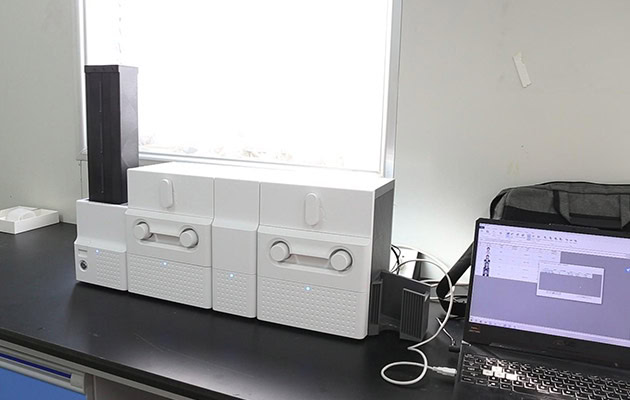
In the previous article, we introduced common issues in ID card printing. Today, we will continue to expand to the next topic, thirteen matters needing attention in the security lamination of cards.
Although the whole process from card to personalized printing to hologram overlay is complex, we have integrated it into a one-stop solution.
Just tell us your current project status and needs, and we will have a specific, corresponding, and matching solution for you. For customers, ID card anti-counterfeiting can also be less complicated.
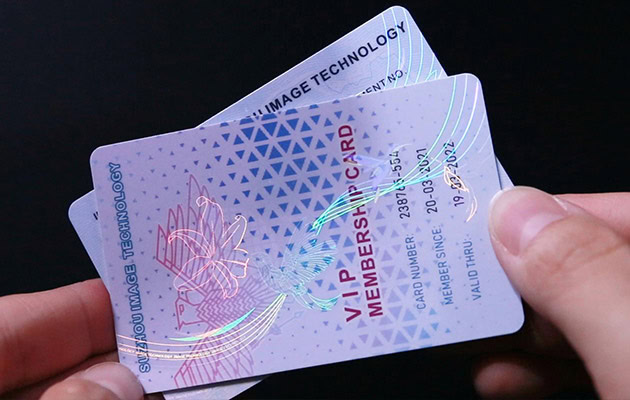
The holographic lamination on the card only solves three main problems. One is scratch resistance, which protects personalized information from being worn out, and allows the use time to be longer.
The other is high security, which can protect personalized information from being forged. The last one is visual verification, which is both beautiful and easy to identify.
If you want to purchase finished cards, you don’t need to consider these issues. However, there are also some customers who want to do lamination by themselves to meet on-site issue requirements, which will be very helpful to you.
Because during the lamination process, if the setting is inappropriate or the operation is improper, it will cause a series of problems, such as overlay pattern deviation, card warping, and even a weak combination of the overlay and card.
Next, we sorted out 12 questions. Our customers often ask or have encountered problems in actual real scenarios. How do we help solve them? I hope it will be helpful to your card project and avoid taking detours and stepping into pits.
1) How to choose laminating equipment?
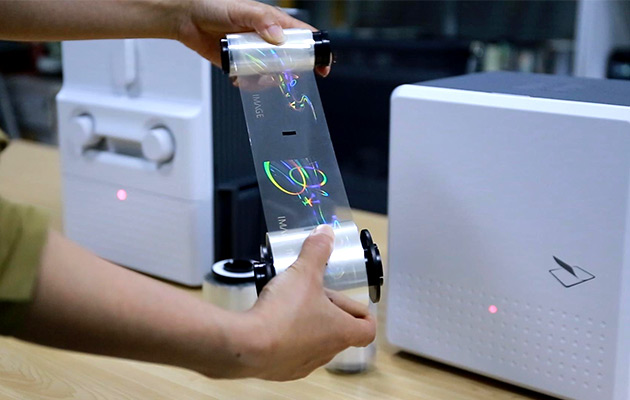
If you use it for a patch overlay, you can choose IDP S70 or IDP S81. If it is a transfer overlay, only IDP S81 equipment can be used. The details depend on the customer’s final product application form.
2) Can my existing laminating equipment use IMAGE overlay directly?
There are many brands of various laminating equipment on the market, such as Fargo, IDP, Evolis, etc. There will be a compatibility issue here.
Because in actual use, different brands of equipment are equipped with corresponding cores and chips, the layout of each piece of equipment is also different.
As long as the customer can solve the problem of the core and chip, there is no problem using our IMAGE hologram overlay. You can refer to this article specifically.
3) Why is it usually recommended to make a customized hologram overlay on cards?
Because the general pattern flows into the market, everyone can use it, although it has the basic anti-counterfeiting function, but it is not unique. Easily forged and copied.
In order to achieve the goal of anti-counterfeiting, we usually recommend that a unique ID hologram overlay be made, such as a national driver’s license, ID card, social protection card, passport, etc.
Moreover, our IMAGE TECH has a professional design team for more than ten years to provide you with one-on-one design services.
4) How many cards can a roll of hologram overlay?
Our patch overlay has 500 pieces per roll, and one-sided lamination supports 500 cards. The transfer overlay is 600 pieces per roll and can laminate 600 cards.
5) Can I have a DOVID hologram lamination on my ID card?
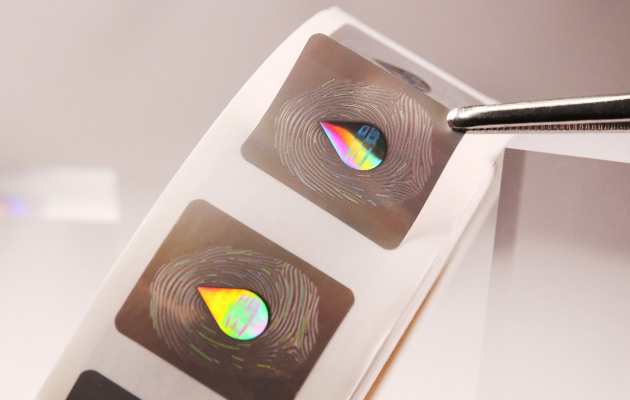
Yes. DOVID is short for Diffractive Optically Variable Image Device. It is a very shiny hologram element with security features.
The dot matrix dynamic graphics can represent beams of light, rays of light, and scaling and rotation effects. Typically, as one of many security features, it is designed into a hologram overlay, which is then applied to ID cards and other identification documents.
6) What is the appropriate temperature and speed for lamination?
For PVC and PETG cards, the reference temperature is 200 degrees, and the speed is 7mm/s. If it is a PC card, the reference temperature is 220 degrees, and the speed is the same as PVC cards.
Specific on-site debugging is required. Usually, if you buy our equipment, we will debug it for your customers in advance.
7) What if the card warps after laminating?
In this case, the heat is usually too high during the lamination process. You can try to adjust the lamination speed and reduce the temperature to improve this.
Speed and temperature are generally negatively correlated; the higher the temperature, the lower the required speed.
8) After lamination, the overlay and ID card can’t work very well. How can we solve the problem?
Usually, when laminating, the temperature is set too low, and the overlay and card cannot be integrated through heating and pressure. You can try to raise the temperature a little. Make adjustments based on the card and surrounding conditions within our recommended 120-200 degrees range.
9) If there is an overlay deviation during lamination, how to deal with it?
For the lamination, you need to care about the location of the patch. For example, we had better make sure the installation of the patch film is correct. Pay attention to the direction of the supplier and take up.
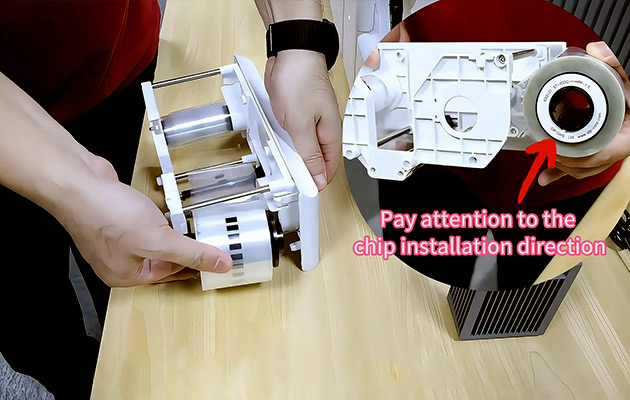
You also need to make sure the location of the patch is in the center. Because the film can go up or down. So we need to care about this. Care about the location, we can adjust the position of the film on the card.
We have a solution. Before the customer buys the machine, we can do the lamination test in our factory. We provide a computer solution, including the pre-printed cards, the machine, and consumables, including the patch and the printing ribbons.
10) Some customers wonder if our overlays can be laminated onto their cards. Is there an effective way for us to do the testing?
So we can do the test for customers before they buy the machine. And we will provide complete training we will provide technical support for customers to use.
11) Would you send me a product sample before I place an order?
Of course, a stock sample is available for you to test quality, but freight cost is on your side.
12) How about the minimum order for the overlay?
50,000piece, about 100roll. We can laminate about 50K to 60K cards. The lead time is 30 days.
13) Are there any problems that need to be paid attention to during the lamination process?
A. Make sure that the surface of the card is clean and free of dust before laminating; the laminating effect will be affected.
Regarding card cleaning, the laminating equipment comes with a cleaning kit, one for each ribbon roll. The cleaning kit is replaced when you change the ribbon.
B. Warm tip: The setting of various parameters, such as laminating temperature and speed mentioned in the article, is only based on our laminating machine as a reference standard.
There are differences in the parameters of different brands and models of laminating equipment. Please refer to the official guidance documents of the corresponding equipment for actual use.
Official cards, such as national ID cards and driver’s licenses, require very high security standards to protect against harsh environments, counterfeiting, and wear.
Suzhou Image Technology’s holographic overlay is ideal for any ID documents that require high security and can withstand harsh environments.
In addition to hologram overlays, we also provide supporting finished cards, printers, printer ribbons, and laminating equipment to provide a variety of safety solutions to better meet your needs.
If you have any other questions about ID card lamination, welcome to contact us. Our optimized, unique security solutions combine perfectly with various ID cards to provide you with the ultimate security.